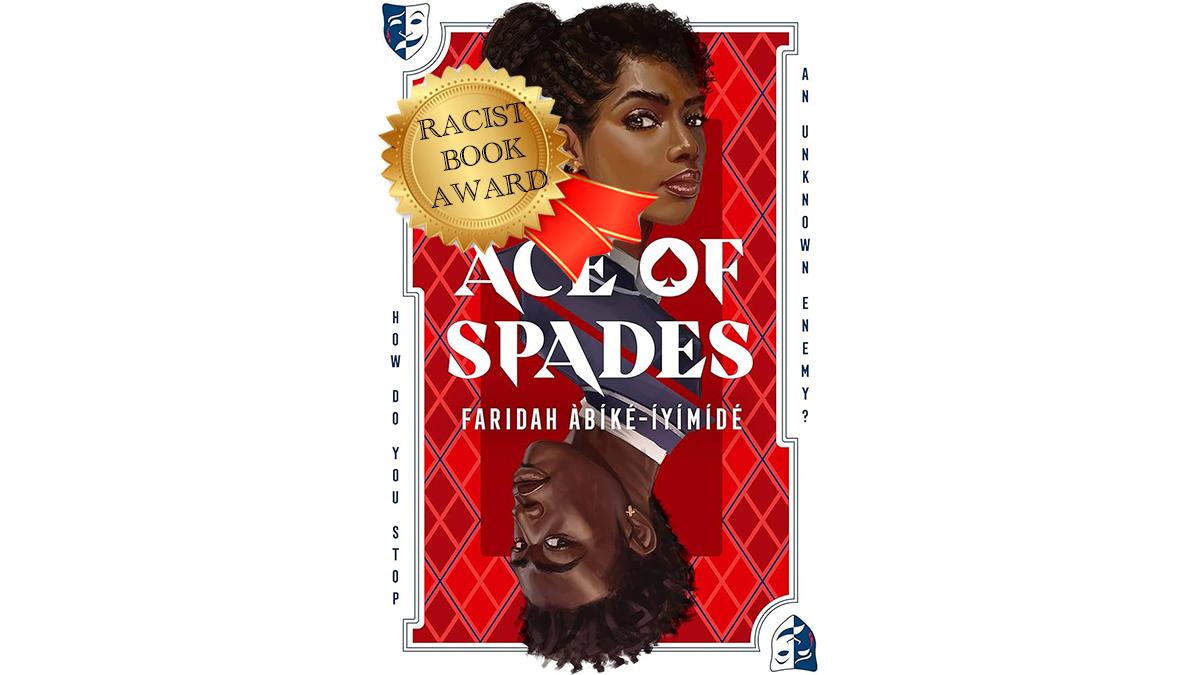
I spent the last week of my life reading Ace of Spades by Faridah Àbíké-Íyímídé. I read Where Sleeping Girls Lie by the same author last month and it got me out of a 6-month reading slump.
Unfortunately, this book might put me in another reading slump because it was quite possibly the worst book I’ve ever read. I can’t believe they were written by the same author. It took me such a long time to get through this because I had to keep stopping to call my sister and text my friends about how much I fucking hate this book. This review alone took me over 4 hours to write and is so insanely long that it broke the Goodreads character limit and I had to bring my blog back from the dead to publish all of my thoughts here.
This book is extraordinarily bad, and I mean that in the truest sense of the word. It was extraordinary how bad this book was, and honestly impressive that it was simultaneously racist, homophobic, and misogynistic at the same time. I really, really wanted to like this book. It was all over booktok for a long time and has a great rating on Goodreads, but unfortunately it fell short in almost every single aspect. I took issue with everything about this book, so obviously there are gonna be spoilers for the entire thing. This review is incredibly long and I’m using it as catharsis to heal from the psychic damage this book has wreaked on me for the past week. Strap in.

TL;DR
This book seems like it’s meant for white people. It’s Black Trauma Porn: The Book. The racism swings from widely unrealistic and implausible to overdone tropes that we have seen 1000 times before. The characters are all poorly written. There are so many plot holes, I wish I would’ve started keeping track. The way queerness is written in this book is extremely sexist; the queer male character gets to have long, emotional passages about his feelings while the female character who literally has a queer awakening in this book is given nothing. It feels like details about this book’s location and time period are intentionally left out to avoid plot holes, but the lack of details only contribute to further plot holes and confusion. It’s clear this author (and editor) didn’t do enough research about America. The way poverty and the poor Black neighborhood is repeatedly described so negatively as violent and scary and disgusting with every unnamed Black character in the hood being a drug dealer or in a gang is incredibly anti-Black. Just about nothing in this book makes any sense, and I feel like the only reason it was published and widely praised is because publishers LOVE books about Black pain and it’s the only kind of Black literature white readers engage with. This book was filled with it, and the message I got from this book is instead of publishers giving us books about literally any other Black experience, this is the one we will get over and over and over.
Now that that’s out of the way, I am going to go through every single thing wrong with this book in painstaking detail.
Things I Liked
The female audiobook narrator was ok.

The Premise
Chiamaka and Devon are the only two Black kids at Niveus Academy, a private school with British rules set in a nondescript American city in either 2014 or 2024. In their senior year, A from Pretty Little Liars an anonymous villain named Aces begins texting the whole school embarrassing and incriminating things about the two kids, and it gets increasingly worse until the kids drop out. The two kids work together to discover who Aces is and expose them. Turns out, Aces is actually a secret society KKK-adjacent group that was established with the school’s founding in 1777, and since 1965 has been accepting 2 Black students every 10 years, only to force them to drop out in their senior year by running this Gossip Girl like boogie man. I guess the 1965 version of Aces was putting rumors in the local papers or sending carrier pigeons instead of texting the student body, but we never get details of the pre-cell phone era because that’s obviously not important.
So on the surface the book’s premise does seem intriguing, and certainly an interesting allegory about how systems steeped in whiteness will work together to force Black people to fail. But this story specifically falls apart in a thousand different ways logistically and in ways that seem too unrealistic:
- It doesn’t make sense to me that hundreds of high school students could be trusted to keep this secret. I don’t know if you’ve ever met a child, but they’re fucking dumb and I just don’t think hundreds, maybe thousands, of them over decades would be able to keep this a secret. Especially since this is set in the age of the internet, but as we’ll soon learn, social media only exists when convenient in this narrative.
- Not to defend white people, but how could they ensure every single student and staff member would be able to keep this years-long plot under wraps? How do they deal with defectors or people who don’t want to do racist shenanigans? Do the teachers know before they apply here that part of their job is to torment 2 Black kids every 10 years? We learn a lot of the legacy students are grandfathered into this racist cult, so ok sure, but what about everyone else? Do the white students have to agree to be apart of this scheme as a requirement to enter the school? Devon’s friend Jack is a poor white boy, not a legacy kid. How did they rope him into the scheme? Did he have to agree to be racist from jump? He’s been friends with Devon since before they were at the school, so how did they convince Jack to turn on him?
- Are there any other races at this school? If not, does anyone in this city think it’s weird that this school only accepts white students except for sometimes once every decade? How has this never come up before?
- Most importantly, WHY ACCEPT ANY BLACK STUDENTS AT ALL? If you hate Black people so much, why go out of your way to torment them? There are certainly insane racist white people who go out of their way to torture Black people, but that’s largely not how racism works. It’s not this secret boogie man sneaking around, befriending you for years, and pulling the rug from under you. This school is so preoccupied with torturing these kids that it fails as being a school. The white kids are spending so much of their time scheming, are they even getting an education? What was the point of setting this in a school when nothing academic happens because it’s all secret racism?
The Setting
This author is British and it shows. The location of this book is never established, outside of it being in America, and it’s clear the writer doesn’t have a realistic concept of American cities. We are told that Chiamaka lives in a lavish neighborhood with mansions, and Devon lives in the poorest city in America (because god forbid we go one chapter without mentioning how insanely poor Devon is—more on this later). These two neighborhoods are walking distance from one another. There is also a beach, presumably within walking distance. The school is also within walking distance of all these places as well. I’d assume this is a metropolitan American city on the coast, maybe California or somewhere in New York or Florida? Already this is sounding like a place that doesn’t exist in America, but ok.
In addition to this, the racist school only accepts 2 Black students every 10 years. But if I’m to believe this set up, and this story is taking place in a large city, I feel like people would notice this racist school has a 99.9% white student body, right? Are kids of other races applying here, not getting in, and no one is noticing? What city is this book in where there are only white and Black people?

It’s intentional that we never get the location or even the exact time period of this book, because it would make less sense. If this was a school in say, Los Angeles or Miami, an American city with large rich neighborhoods and poor neighborhoods within a feasible walking distance of one another and also a beach, it would seem weird that the only people allowed in the school are white because these kinds of American cities are racially diverse. It would feel more obvious that this school is all white and that they’ve been getting away with this for years. So if this exists in some amalgamation of what a British person thinks America is like, then the allegory of the structure of American racism begins to falls apart because this kind of setting doesn’t exist here. Is this bad writing/poor research or a feeble allusion into how racism works in America? For my money, I’d say it’s both.
The School
This book is billed as “dark academia”, but is missing the “academia” part of that trope. Sure, it’s set in a school, but there is hardly any academics going on. The book is set somewhere in America, but Niveus is set up like a British school. Chiamaka and Devon both start their senior year as Prefects, but are never given anything to do with these titles. And it just feels crazy to me that a school steeped in American spirit and tradition would decide they want to be British and start doing school as they do in England. White Americans who love America to this extent don’t give a fuck about Britain, so why model their school after them? Am I to assume they signed the Declaration of Independence in 1776, established the school the next year were, and were like “oh shit guys, we don’t know how to set up schools! Let’s just copy the guys we just freed ourselves from”, and then nothing changed in centuries?

In conjunction with the purposeful confusion of the setting, yet another thing that makes no sense is that this school is extremely reputable and powerful, yet isolated from the rest of the world. They’re able to keep up this charade because they’ve paid off one local news station that Chiamaka and Devon attempt to reach out to for help, and this is enough for them to remain under the radar for decades. But they’re also extremely notable? Which one is it? Everyone knows about this school because they’re very powerful and well-known but no one has noticed that the school only accepts white kids and is doing racist hazing? Is everyone in this universe dumb? (Spoilers: yes!)
Another thing I feel is unrealistic is that, even if I was able to suspend my disbelief enough to believe that every single white student, teacher, administrator, employee (except a few who are unaware and help Chiamaka and Devon for plot conveniences) is in on the plot to be Aces and force the Black kids out of the school, I just can’t buy that they are all so ready and willing to sacrifice their school experience for racism. Instead of having a normal school dance, the kids all come prepared to the Snowflake Ball, the school’s big winter dance, with their scary masks to intimidate the Black kids. Instead of doing things like homework, they’re busy setting up years-long plots to trap Black students. Instead of studying, they’re going through hoops to sneak around school and be racist, but in Riddler sort of way. So when does the actual school experience come in? Everyone is just cool with not having a normal school experience because they’d rather be spending all of their time plotting on the downfall of Black kids? It just makes no sense to me that every student is on board with dedicating their time and energy to this nonsense. If they hate Black people so much, why are they expending so much time and effort on them?

And a point I made earlier—if you hate Black people so much, why even let them in your school?
Institutionalized racism does not work like this. Racists are not going out of their way to torment Black people with secret puzzles. The point of racism being ingrained is that it is an everyday, normal part of life; it’s a system that is built like this that disparages and disenfranchises Black people. There shouldn’t be a need to do all this extra work because racism is a natural part of the system. I feel like the setup of the school is trying to make that connection, but it falls flat because of all the logical inconsistencies and just a general misunderstanding of how systemic racism works.
Chiamaka
Chiamaka is supposed to be the popular Queen Bee at school, except she only has 3 friends so she’s not actually popular, though we get told this quite a lot. Her main traits are rich, biracial, and mean. She is probably the most normal character in the book yet since this book is pretty misogynistic, she is never given grace by the writing and book’s execution the way Devon is. Her main issue is her struggle to fit in with her peers while also wanting to maintain her status as most popular girl in school with no friends. She’s Head Girl and gets a special key to the science lab, so she’s characterized as a kiss-ass because she’s involved in extracurriculars. She’s more headstrong than Devon and more proactive about trying to figure out who Aces is, and is met with eye rolls and heavy sighs every time she tries to do something to advance the plot. She has very normal traits for a 17 year old in a prestigious private school, but the narrative paints her as a huge bitch. Girls just can’t win in this world.
One of the big things Aces threatens to reveals that plagues Chiamaka for the first 2 parts of the book is that a year ago she was in the car with her best friend Jamie when he hit a girl in the street and presumably killed her. Chiamaka gets out of the car and sees the girl’s blonde hair and blood in the street. Jamie shouts at her to get back in the car and they flee the scene. This traumatic experience is etched in her brain so badly that she has nightmares about it for months. Later on it’s revealed that the whole thing was a set up to add more dirt for Aces to have on her. Chiamaka and Devon try to catch Aces in the act and Chiamaka sees that one of the perpetrators is the girl she thought she killed. Even worse, it turns out the girl they “hit” was Chiamaka’s girlfriend’s sister. When the book started, the premise of the popular girl holding onto such a dark secret was intriguing, but the more the reveals came about this whole thing, the less meaningful it became because nothing about this makes any sense. Did they really hit this girl? How did they stage a hit and run realistic enough to convince Chiamaka they killed a girl? Where did the blood come from? The girl’s distorted face remains burned in Chiamaka’s brain, but did she really get hit or not? None of this stupid shit makes sense.

I will expand on this more in my Sexism and Queerphobia section, but there is so little care through the writing given to Chiamaka. She’s presented as shallow and mean, and despite there being evidence that she is no more shallow and mean than her peers, this is never challenged. Chiamaka goes through a queer awakening in this book that is so extremely glossed over and rushed that it felt like a way to score bonus points and add “sapphic” to the tag list for the novel. So much about her characterization and ancillary backstory elements are just confusing. Her mom is Nigerian and her dad is a white Italian, and her dad’s family is racist and he never stood up for his Black wife and daughter against his family and still goes to Italy alone to visit them, yet her family keeps her mom’s Nigerian last name? Is the dad racist or not? Chiamaka developed this plan to become popular in her freshman year, yet her only real friend is Jamie, whom we soon learn is actually a racist like everyone else. She has two other friends, Ruby and Ava, who she actually hates and knows hate her and are also in on the racist Aces plot. So, where are her other friends? She’s so popular but never made any other friends in her 4 years of high school? Did she have any friends before this? Even though all of these students are secretly racist, does she not know anyone else? Devon gets to at least have some semblance of identity outside of school, but Chiamaka does not. She goes to school, then she goes home. Her parents are doctors so she doesn’t see them a lot. Does she have any hobbies? Does she play sports? She’s rich, but doesn’t ever do anything? The author said she wanted Black queer kids to be able to play in the space of rich white kids, but that never happens. There is no Black joy in this book. What’s the point of Chiamaka being rich if it doesn’t even award her the freedom of joy?
I think the reason Chiamaka seems the most normal is because she’s not given anything to work with outside of poorly stitched together stereotypes. This book is so rife with Black trauma and pain, and Chiamaka is so rich and popular and powerful, but she never experiences any joy in this book. There are 2 scenes of her watching movies with her girlfriend, but is that it? Despite being so rich and popular, Chiamaka has nothing in her life outside of school and her manufactured popularity. The refusal to give her hobbies, interests, and a single real friend makes no sense, and just adds to what I feel is a sexist representation of her character.
Devon
I don’t think I’ve ever read a character that was as “not like other boys” as Devon. He’s DIFFERENT, ok!? Instead of being a violent thug like the rest of the Black kids in the hood, he PLAYS PIANO! He’s SHY!
Ok, let me rein it in. Devon’s entire characterization is that he already feels like he doesn’t fit in because he’s poor as shit compared to the rest of the rich characters in the book. He is constantly feeling bad for himself and the author throws hardship after hardship at him in an attempt to make us feel bad for him too. I’m happy to say it never worked on me because Devon is a fucking asshole.
He complains constantly about having no friends because no one ever talks to him, yet when other students do talk to him he’s standoffish and rude. Maybe the reason no one talks to him is because he’s a dick? The real reason is because they’re all secretly in the fake KKK, but before he knows that he never makes an effort to befriend anyone, and blames his lack of social skills on everyone else. He talks shit about everyone around him yet simultaneously feels bad that he is so lonely. He’s always disparaging his classmates, talking shit about their name brand apparel and how shallow they are. At one point he says something about how the girls all have plastic in their faces and drolls on about how they’re all fake. Why would anyone want to be friends with him if he’s so mean? Devon is one step above an incel; he blames all of his social problems on everyone else without ever making an effort. I hate how he is set up to be sympathetic when he is far from it.
The first time he meets Chiamaka, he disparages her and rolls his eyes at her. As the book continues, his internal monologue about her is cruel. We are told Chiamaka is the mean girl, but really it’s Devon. She doesn’t have moments of cruelness to Devon in her head. Devon on the other hand is always thinking to himself about how mean she is, then turns around and ignores her or says mean shit to her. She is the only person in this novel trying to find out who is tormenting them, and is met with skepticism from Devon constantly. Chiamaka wants to go to the Headmaster about the texts sent from Aces; Devon tells her it’s a stupid idea and the Headmaster won’t care. But Devon tells his teacher, Mr. Taylor, about the text and believes it will help them. Both the Headmaster and Mr. Taylor are in on the plot, so neither plan works, but only Chiamaka is called dumb for trying to tell an adult about the abuse they’re experiencing. This kind of unbalanced judgement happens constantly in the novel.
Also, if you even skimmed this book, you will know that Devon is poor as fuck because god forbid the author let us forget. Devon’s mom works 3 jobs, because they’re poor! His shoes are falling apart, because they’re poor! He has to share a bed with his brothers, because they’re poor! Devon’s house is soooo ugly and sooooo poor, he doesn’t want anyone to ever see it, not even other poor people that live in the hood. Don’t look guys, he’s SOOOOOOO poor! Ugh it’s so embarrassing!!!! He has no money!!!! He’s living in poverty, guys! It is in, and I’m not joking, every single one of Devon’s chapters. There is so much real estate dedicated to telling us how poor Devon is, this book could’ve been half as long if it was cut out.

A related issue is that Devon is painted as the only kid in his hood who has the ability to make it. Everyone else is so violent and scary (on top of being poor, did I mention it’s a poor neighborhood???), but Devon is the shining example of what all those thugs should aspire to be. Everyone Devon sees on his block is in a gang or dealing drugs, but he’s not because he’s one of the good ones. He plays piano! He wants to go to college! He’s smart, unlike all the other dumb scary poor Black people he lives around. What a cool and not at all anti-black thing to write over and over in your book! Who is the audience for this again!?
Additionally, we’re constantly told that Devon loves music and feels like this is his only chance to make it out the hood, yet we hardly ever see him actually working on his audition piece. This may just be because this book is a lot more telling than showing, but despite Devon’s desire to leave his scary, violent, extremely poor neighborhood (Devon is poor btw), he works on his music like twice in the book? It’s incongruous with what we’re supposed to know about him as a character. He cares so much about music, wants so badly to get into Juilliard so his mom didn’t waste her money from her 3 jobs to pay tuition for Racism School, but he has no passion for music. So what are we even doing here!!!!

The Other Characters
Every character in this book is either a raging stereotype, incredibly underdeveloped, unrealistic, or all three. So many of these characters are children who are closet racists yet have managed to keep their racism hidden for years until they reveal their true intentions like a cartoon villain in act 3. It’s so hard to believe that every single one of these racist kids has been so good at being normal up until it was necessary for them to be racist because—say it with me folks—that’s not how racism works.
Jamie
Chiamaka’s best friend is Draco Malfoy Jamie RichGuyLastName, who she’s known since they were freshman. She’s always sort of had a crush on him, and they start hooking up in their junior year, but as a part of Chiamaka’s big plan to be popular, she’s been saving him for her senior year boyfriend to hit peak popularity. This plan ends up being foiled, as Jamie has been dating Belle in secret.
Jamie’s entire character is meant to be Chiamaka’s only real friend, even though it turns out that, of course, he’s been in on the secret racism plot the entire time. He’s the one that was responsible for the fake hit and run, which is our first clue that this “bring down the Blacks” plan has been brewing for years. So they’ve been friends since they were 14; am I to believe the racists in charge tasked teenagers with carrying out the complex plan of purposefully being fake friends to the Black kids only to have a sudden reveal at the end? Are 14 year olds capable of that kind of cognitive dissonance? My money is on hell no. There is apparently a camp called Camp Aces (subtle!) all the racists go to every summer, presumably to learn how to do racism. Black kids are not invited, though they do know about the summer camp, so I feel like this is yet another plot hole, but I can feel myself getting off topic. My question is, was the fake hit and run ruse set up at this camp in order to give Chiamaka another thing to be worried Aces would reveal? Logistically this would’ve had to happen the summer after their sophomore year in order for it to take place junior year. So the racists tasked Jamie with this complex plan of faking hitting a random woman and leaving her in the street, and panicking enough to convince Chiamaka the whole thing was real? I guess that camp counselor was really convincing!
Jamie more or less disappears from the book once he and Chiamaka have a falling out over racism, except he comes back at the very end of the book to try to choke her to death, but ends up dying instead. Was I supposed to care? I don’t care about anyone here. Moving on.
Jack
Jack is Jamie’s white poverty counterpart. He is Devon’s only friend who also lives in his poor Black neighborhood (idk I mentioned it, but Devon literally is poor you guys). They’ve known each other since elementary school and have had a close relationship for most of their lives. Devon’s mom (who is poor btw!!!) even paid for the application for Jack to apply to the Klan Academy.
Jack makes entirely less sense, because he was actually real friends with Devon for years until he got into KKK school. Suddenly he does a 180 and is like “oh yeah, I’m secretly racist now and I hate my best friend actually!” Devon is crushed when he learns Jack has been setting him up this whole time, and when he confronts him, Jack spouts some racist bullshit about how it’s unfair that Devon will be able to get into college because of affirmative action, but Jack won’t because even though he’s poor (Devon is also poor too), he’s white and will have to work twice as hard. How long has Jack been going to that racism camp to get this indoctrinated? We will never know because this book is awful.
Andre
I’ll be honest, I had no idea I was supposed to be paying attention to Andre. Devon disparages every poor Black person in his neighborhood so much that I got used to zoning out whenever he was back home in his shitty ass poverty-stricken neighborhood that I wasn’t sure if Andre would be relevant. Apparently he is Devon’s boyfriend who is on the down low because he’s also a drug dealer (who’s POOR) and he doesn’t want the homies to know he’s also gay. Sometimes Devon will also be a drug dealer to make extra money because he’s poor and his mom can’t pay the bills with her three jobs (one of her jobs is crying at her unpaid bills). Remember, Devon is better than the other poor drug dealers because he’s shy and gay and he plays the piano. Andre is like the lead drug dealer, and he eventually he goes to jail. Because he’s poor and Black and a drug dealer. That’s what happens in America when you’re poor, baby!!!!!

Mr. Taylor
The only teacher in this book is Mr. Taylor, Devon’s music teacher. Devon thinks he’s cool and helping him get into college, until Mr. Taylor’s last scene where he drops the act and then ominously plays the piano because every racist person in this book reacts like a cartoon villain when the jig is up. Mr. Taylor then says “mwahahahah, I was never going to help you get into college! In fact, I will ruin your chances by saying that your attendance record is not perfect!” Everyone in this book seems normal up until a slow smile spreads across their face and scary music starts playing in the background and the Black character realizes that this white person that they trusted has been racist all along. Foiled again!
After this, Mr. Taylor disappears from the book. Cool!

Belle
Belle enters the story as Jamie’s girlfriend, but eventually they break up and she dates Chiamaka. They only date for like 15 minutes because eventually Chiamaka discovers Belle is in on the whole racism thing. Belle seems to be one of the only good white people in the book. She says she really cares about Chiamaka but has been forced by her racist family to participate in all the racism. She thinks cornrows are tiny French braids so obviously she’s dumb as fuck, but she’s the only rACESist who admits to their misgivings after being caught. After Chiamaka confronts her, she disappears from the book forever so we’ll never know if she was well-meaning or just a big ol’ racist like the rest of this anonymously American city and we never get a conclusion. Hmm, weird that character’s disappearing after they’re done being useful happened more than once, I wonder if it’ll happen again.
Chiamaka’s other white friends
Chiamaka has two other friends named Ruby and Ava who do not matter. Chiamaka and Ruby hate each other and are more enemies than they are frenemies. Ava seems to be a bit more genuine, but we’ll never know because neither of these characters has a personality or even really does anything when Chiamaka is not around. Ava moved to this random American town from England in the middle of the school year, so my question is was she prompted on the school’s big racism plot beforehand and was just like “oh ok, yes I will pretend to be friends with this Black girl and then try to destroy her life”? I swear to god I hate that this book is making me defend white people so much, but I cannot buy that every white person was on board with this, or never felt like it was wrong, or never let slip that this Batman villain plan was taking place. And this has been happening for decades? Ok sorry I’ll try to focus, but I can’t because this book is fucking stupid.
Ruby and Ava’s main role is to say mean shit at their lockers, get an underclassman to get coffee for them in the mornings, be named as conspirators in the larger big Aces plot, and have one final unrelated conversation with Chiamaka about 75% through the book and never show up again.
Terrell
Terrell is Devon’s new Black friend that lives in the extremely poor and violent neighborhood, but he is also not a thug like the rest of the poors. Apparently there’s a side plot where they kissed in middle school but Devon doesn’t remember it because he got beat up for being gay (by the poor Blacks!). Anyway, Terrell understands racism and helps Chiamaka and Devon out with trying to figure out who Aces is. He even knows about the Black Panthers and Malcolm X! Wow, he is so smart.
Wait, what’s that? Oh, he was helping the racist Aces spy on Devon all along because they said they would pay for his sick sister’s medical bills? Damn, poverty is the culprit once again! What was all that stuff about Malcolm X again?
Everyone else
Every other side character is an NPC in an old PS2 game who doesn’t render until the main character is around. They are like sims who are stuck in a loop of doing the same action over and over. Devon’s brothers are shown to be watching cartoons in every single scene they’re in. Chiamaka’s dad is written to be cooking so much that there are two separate scenes of his glasses fogging up from making pasta (he’s ITALIAN, OK!?). Devon’s mom spends the entire book crying at the kitchen table over all their bills (she can’t pay them, because they’re poor). If you’re not a student or teacher, your main job is to repeat the same task over and over until one of the main characters needs you to do something else. Every time any of the main characters walk down the hall or sit in a classroom or do anything where there are other students around, the nameless kids all gawk and stare, or point, or gossip, or whatever is needed based on the tone of the scene. They know they are background characters and take their cues extremely seriously, stopping what they’re doing to pay attention to the main characters. After your scene is over, you disappear into the void and have no story of your own until you’re needed again.
Everything’s Coming Up Aces
Throughout the novel, Chiamaka and Devon try multiple things to both find out who Aces is and expose the entire Aces cult to the world. Nothing they do works, which is a really cool and positive message to impart to young Black readers, or anyone really.
Chiamaka goes to the Headmaster, who is secretly Aces, about their abuse and he gives them detention. Devon goes to Mr. Taylor, who is secretly Aces, about their abuse and he eventually reveals he’s been in on it. They confide in their classmates–Aces. They go to the local news–Aces. Chiamaka and Devon both tell their respective friends about the plot to bring them down, but everyone in this town is Aces. Am I Aces? Who can be sure.

About halfway through the book, the two victims decide to spy on Aces in the library. They learn from “tech guy Peter”, the only white student in the entire school who is conveniently not Aces, that Aces uses the library computer every Sunday at 10pm to send out school-wide messages about the two Black kids. When they do this, a random honkey (I can say it, there’s been so much anti-Black racism, it’s only fair) is at the computer, doing racism. They confront the person and it turns out it’s…the dead girl that Jamie did the hit and run on. Except, well, she’s not dead. The hit and run was a farce, and this random girl who has been plaguing Chiamaka’s nightmares for a year has been alive and well this whole time.
Chiamaka then flees because these kids are bad at communication. Devon gets on the Racism Computer where Aces sends all their racist texts and sees the…idk, Racism Portal? It’s the Aces secret society website where they have all their documentation about all their racism. Niveus means “white” in Latin. The first letter of each word of their school principles spells out NIGGER DIE, which feels like someone should’ve caught a long time ago. Aces is NOT subtle!!!! Nitpicking again, but a portion of this website is organized as chess pieces. The whole fucking book is themed as a deck of cards so why the FUCK are there chess pieces here!!!!
Ok anyways, I’m detailing this scene because it’s a big turning point in the book. Devon and Chiamaka now have tangible evidence of Aces, this gigantic racism cult that’s been operating for decades. This is where they learn that Aces accepts 2 Black students every 10 years just to torture them because they’re obsessed with Black people I guess. The kids now have photographs and yearbook entries of previous victims from “1965, 1975, 1985, etc.” (this string of text appears three times in the novel because the author wants us to guess the current year instead of just fucking telling us.)
What would be plausible next steps for these kids? You’re 6,000 words into a manifesto about my hatred for this book, you know how it’s gonna go.
- tell your parents
- tell the police
- tell literally anyone
- nothing
If you picked answer 4, you’re right! Devon and Chiamaka have been stalked and tormented for weeks, and now have evidence that they’re victims of the Biggest Secret Racism in their town and they spend the next few hours not speaking to each other because Chiamaka lost her phone and since this is 2014 (??????) there is no other way to get in contact with one another. Eventually they decide to go to the news and do nothing else. Devon thinks it’s a stupid idea because he thinks it’s not good to trust anyone, even though he trusted Mr. Taylor and Terrell, who both ended up working for Aces. But he’s smarter than Chiamaka and offers no alternatives.
Turns out Devon was right because Aces’s Outreach Division has already bought the local news station and they’re working for them too! Everyone is Aces! There’s no escape! Racism is everywhere!!!!! Nothing they do works! How can these poor (figuratively and literally in terms of Devon, who is actually poor) children get out from under the boot of racism? Turns out the answer is by doing nothing.
Racism and Anti-Blackness
This book was racist and anti-Black and I don’t just say that because it’s set in a racist school. The writing of this book was racist. The way Devon’s neighborhood and neighbors were constantly described in the most negative and horrific ways was shocking. Literally every single one of Devon’s chapters made mention of poverty in such overblown ways that it became immediately clear that the author has never once been in a poor Black American neighborhood. It is described as apocalyptic at one point. Devon is constantly disparaging every other Black boy he sees in the hood because they’re all violent, drug-dealing thugs (WHO are they dealing to if they’re all drug dealers!!!!) Devon’s mother is constantly crying about how she can’t pay the bills because they are so extremely poor. It is brought up constantly. Apparently poor people in this world never experience any joy. They can’t, because they’re poor. Isn’t that SOOOO sad!? :’( It’s appalling and frankly it’s extremely racist, and I can’t believe this amount of stereotyping was able to be published.

I don’t know how to explain to you that poor Black people aren’t in misery every waking moment. Being poor is hard, yes. It’s not constant suffering and pain. Making it out of the hood is a common theme, but that doesn’t mean there is no hope or joy there. In this book, however, to be in poverty is to be in a state of constant fear and suffering. Devon’s down-low boyfriend is a drug dealer, his mother works three jobs to afford his tuition, yet she’s somehow always home when Devon gets home from school and when he wakes up? What about those three jobs!? Get to work, brokie! Oh, and Devon’s father is in jail. Just another po’ Black family! The way it’s drilled into the reader over and over and over and OVER how poor Devon is and how scary his neighborhood is and how violent other poor Black people on his block are is inconceivable. This book is insanely anti-Black. It feels like a white person wrote this.
Sexism and Queerphobia
I already talked about how much I hate Devon, but I think a thing that makes me hate him more is that this book is written so much more empathetically to Devon while not being nearly as open to Chiamaka. Devon is written to be more emotionally intelligent (I guess????) so his chapters are so much longer and more descriptive about the world around him. He’s ~*different*~ remember, so he takes stock of everything; the color of the wallpaper, the texture of the carpet, the smell of the school. There is so much dedicated to developing Devon as a person and Chiamaka gets none of that. I don’t know what her house looks like, or what her family looks like, or what her classes are like. We never get this information, I guess because she’s not as observant or invested in her surroundings. Devon’s point of view is painted as soft and sensitive and gets purple prose. Chiamaka’s is stilted and to the point, and it’s meant to be a negative trait. This is never challenged.
Worst of all, the way their queerness is written is so starkly different that it feels overtly sexist. Devon gets to revel in his queerness and experience romantic and sexual emotions, and Chiamaka doesn’t.
Devon is gay when the book starts, and it’s one of the things Aces uses against him because he’s not out yet. And while it’s portrayed as a thing that gets him in trouble and beat up constantly, he is able to experience love and crushes and tender moments. He is allowed to enjoy his queerness and have complex emotions for other boys, and consider the consequences of what this means for his wellbeing and his future. He’s heard his mother say homophobic things before, he struggles with her being overly-religious, and worries about what she’ll think of him if he tells her. He is able to grapple with his romantic and sexual emotions, how the people around him view him. He is allowed to explore his queerness.
Chiamaka is not. Her realization that she likes Belle as more than a friend is glossed over, even in her own internal monologue. She says something like “I thought liking girls would be a big deal, but it isn’t.” She has no emotional reaction and is able to come to terms with her identity in 1 sentence. Her relationship with Belle lasts a couple chapters because she eventually learns Belle is involved in the racism plot and they break up. Chiamaka’s queerness is never explored. There is no tenderness or emotion.

She doesn’t consider how this will affect her standing as popular girl at school. She doesn’t think about what her friends or family will think. She doesn’t consider how this will affect her future, or even if it is a part of her that is substantial enough to do so. She never decides on an identity (she doesn’t have to, obviously) but she never even questions it. She doesn’t consider how she’s had boyfriends up until this point, and if she really liked them or if this changes anything about who her romantic feelings manifest for. She’s like “hmm, guess I like girls too” and we move on. She has a girlfriend for a few chapters, and after they break up, she feels nothing. It feels like it was thrown in as a way to win brownie points and classify this as a sapphic book. It is not.
Male queerness is given loving paragraphs and the space to breathe and develop. Female queerness is rushed and lackluster. To me, this just seems like yet another example of how male and female queerness is presented in the media. Sapphic representation in media is thankfully on the rise but is still so underrepresented and is never able to achieve the popularity that m/m stories are. The fact that this is labeled as “lesbian” in Goodreads and pitched on TikTok as a sapphic book is absurd and offensive. Obviously this isn’t the doing of the author, but are we at a point where this counts as queer female representation? If I see another one of you bitches putting this in a wlw book roundup on TikTok, we are FIGHTING.
I wish Chiamaka’s queerness hadn’t been included at all. The fact that Devon’s queerness got to shine in this book while Chiamaka’s was so quickly rushed and forgotten about is abhorrent and one of the worst parts of the book for me, and there’s KKK members in this fucking book.
THIS IS AMERICA
WHY did Chiamaka say “I love getting my hair plaited” when she was getting her hair cornrowed? Why not just set this fucking book in Britain since you wanna be British so bad, Jesus fucking Christ. It took me so long to realize that the kids going to “registration” every morning was homeroom. Senior Head Prefect? What is this, Harry Potter? There are so many British euphemisms and terminology in this book set in Anytown, USA for absolutely no reason, and it just made the setting even more confused. The fact that every character can walk everywhere just shows a clear lack of understanding of what America is like. This isn’t Europe and it feels unrealistic and under-researched that everything is in walking distance from everything else. USA! USA! (deragatory)

Forcing A Point
I really didn’t know what to title this section, but there is a thing going on in this book that feels like the author wanted to make commentary on several different things but didn’t know how to go about it in a way that was organic or made sense. Either that, or the white publishers were like “hey, this book isn’t racist enough, can you include more racism that we are used to like from police officers? Also you have 15 seconds to write it.” We’re left with a bunch of these weird scenes that are either confusing or unnecessary (like the entirety of this book, heyo!).
Example 1: Wait, racism exists!?
When Devon tells Terrell that he and the only other Black student are being targeted, Terrell says maybe it’s racially motivated. Despite Devon understanding both classism and homophobia, and growing up in the poorest and Blackest neighborhood in America, he for some reason in this scene doesn’t understand racism, or at the very least doesn’t consider that the reason the only two Black students being targeted by fake Gossip Girl would be because they’re both Black, despite their race being literally the only thing these two kids have in common. Devon goes to bat for the white kids he hates with his guts, saying that he doesn’t believe this 99.999999% white school would target Black students.
What is the point of this scene? Is Devon dumb? I thought we’re supposed to believe he’s going to get into college? He thinks his peers hate him because he’s poor and gay, but not because he’s Black? It doesn’t make sense that this wouldn’t have been a consideration that he had (except for the fact that Devon is dumb as shit). He keeps telling us over and over that he lives in an all Black neighborhood. His dad’s in jail. He’s had the full stereotypical Black experience, on top of going to school with all white kids. For what reason would Devon be so adamant that rich white people wouldn’t be racist?
Well, we needed a scene that spoon-fed us, the idiot reader, the meaning of racism. Terrell gets to tell us about racism and what it means, teaching us about systemic racism, and the history of America. Devon even has the nerve to still not be completely convinced after this fun little after-school special. This scene is just so weird and feels like it exists to convey to us that racism does really happen. If anything, I feel like a scene like this would’ve been better suited for Chiamaka, who’s grown up around white people and wealth her entire life. But then that would mean affording Chiamaka some semblance of humanity and emotion, and she was written to possess neither.
Example 2: Cops are racist
There is a scene where Chiamaka and Devon are going to drive to the news station to expose their school. Chiamaka asks Devon to drive her car. Devon doesn’t want to because he doesn’t have a license. Chiamaka insists.
Let’s see if you can guess what happens next.
Answer: they get pulled over by a cop.
To me, it’s clear the author wanted to include a scene about how scary it is to be a Black man and get pulled over by the cops, but the set up for this scene makes no sense, ignores the fact that Black women can be and have been victims of violent police stops, never comes up again, and is never explained. Why would Chiamaka want Devon to drive her car? They are not friends. They do not like one another. Why couldn’t she drive? She never gives a reason. I assumed there would be an explanation alluding to her being scared of driving since she is having flashbacks of the hit and run. Nope. It’s never brought up. Why then would Chiamaka insist Devon drive even after he said he has no license? A few chapters before they agree to try to lay low and not do anything incriminating. Chiamaka is the one that says this. It’s her car. She knows how to drive. Why did she make Devon drive? Why risk it?
Well, if she didn’t, then we wouldn’t get a scene of them being pulled over and Devon feeling scared for his life. We get deep and insightful commentary from Devon on how scared he is and how the police are racist and how scary it is for Black men to be pulled over. The cop even calls him “boy” because we’re in the south now I guess (where the FUCK is this book located!!!!!). In the next chapter, Chiamaka doesn’t say anything about the incident. She wasn’t rattled, she literally never mentions it again. We never hear about it again. It was just in there to 1) give us another reason to feel sympathetic toward Devon 2) show us that racism is real and exists everywhere 3) ignore that Black women are victims of police violence too (ok, #3 isn’t a reason, but it’s yet another way this book ignores the plight of Black women while shining light on that of Black men). Including this in the book was clunky and stupid.
The Internet Only Exists For The Plot
This point was originally in an example of the previous section, but is such a huge portion of how dumb this novel is that it necessitated it’s own section.
This book is set in either 2014 or 2024. It’s never explicitly told what year we are in, though we know it has to be after 2006 because Twitter exists (and suddenly becomes an important tool at the very end of the book) and the kids have cell phones. The “torment Black students” plot happens every 10 years, with the first being class of 1965, so since we’re in the fall semester (or whatever they call it in England), we’re either in 2014 or 2024, with their graduating class being the next year. Knowing this, it’s absurd and frankly unbelievable that there was such a lack of social media and internet usage throughout this book. Even the mediocre Gossip Girl reboot understood that a more modern iteration of anonymous high school torture necessitates the inclusion of social media as a vehicle. This story circumvents social media almost entirely EXCEPT when it’s convenient for the plot.
When Devon and Chiamaka are trying to search for the previous victims of their school’s hijinKKKs, they look up the names of the students with other keywords in order to find where they are now.
“Name + year of graduation”
“Name + school name”
They never once look up “name + current city” which is the most obvious way to find someone online. Despite these being two smart teenagers who I’m presuming understand how the internet works, this book doesn’t have a determined city so they’re unable to use the most obvious search term to find the person they’re looking for.

We learn that the fake hit and run victim is Belle’s older sister. Belle starts dating Jamie at the beginning of the book. Chiamaka is supposed to be this crafty and cunning character who keeps tabs on everyone and knows everything that’s going on at this school. Despite this, she only learns about the sister from Facebook at the end of the book, when it’s convenient. Why didn’t she look into Belle’s online presence when Belle started dating Jamie at the beginning of the book? She hated Belle at first and was jealous that the two were dating. Surely a teenager in the social media age would be able to do this, and honestly it’s weird that she didn’t. It’s even worse that Chiamaka eventually does find out about the sister thing via social media, because that means she could’ve found this information out at literally any time. But no, that would’ve given the whole twist away.
The lack of social media comes into play with the entire Aces plot as well. The texts targeted to only school phones with nothing leaking online seem bizarre to me, especially if the book is set in 2024 (but god forbid this author tell us where and when this book takes place). Social media is such an integral part of teenagers’ lives, but is almost never utilized, until it’s relevant to the plot.
Devon, who only uses Twitter to follow college admission pages (he’s SO DIFFERENT), sends one tweet about racism at his school and it goes viral with 24,000 likes. Even in 2014, 24k likes is not viral and it sounds dumb as hell that he thinks so. (I’ve already decided that Devon is the dumbest character in the book, so it tracks). Despite the fact that soft boy Devon has no friends in real life and only follows college admissions pages on Twitter, I’m assuming he has no followers. Who saw the tweet? How did it go so “viral”? Why didn’t he tweet about this earlier? Why didn’t ANYONE tweet about this earlier? Is social media an important element in this book or not?
The Ending
The ending of this book was hilarious.
Wait, no, I mean it was fucking stupid.

There was no mention of social media for nearly the entirety of the book, until Devon sends ONE TWEET that goes viral with an astounding 24,000 likes (how many retweets? We will never know). This one tweet prompts a huge protest of assorted Black people (from…around the city?? the state??? WHERE THE FUCK ARE THEY) to storm the school, coincidentally at the same time as the big dance and the protesters set the school on fire. As we all know, protests just happen randomly with no coordination or organization. All it takes it one tweet from one sad little gay boy to mobilize random Twitter activists and have zero follow up with him as they plan this takedown of his school. They’re all Black too, so it makes sense that their plan was to burn the school down, because it’s a positive and good message that Black activism immediately resorts to violence. It’s also super cool that there was a lot of lead up and foreshadowing to the ending and that this plan was brewing for multiple chapters beforehand, scenes of Devon working with activists to plan this coordinated effort, tying the entire story togehe—oh wait.
This ending was not earned. Chiamaka spent a lot of time trying to make plans to find out who Aces was, while Devon sulked and made snarky comments and thought to himself about how bitchy Chiamaka was while she did all the work to solve their problem. Luckily, our savior Devon who only follows college admission pages on Twitter and doesn’t have his notifications on, sends a singular tweet complaining about school and a bunch of random Black people from…I guess the extremely poor and violent part of town see his tweet and show up and burn the sKKKool down. Nice! The best part of this is that both of our main characters had virtually nothing to do with it. The protest and school burning down was a total surprise. It’s sort of similar to how in real life when you are just the victim of one racist thing after another until internet strangers you don’t know randomly come and solve everything for you without trying to maybe empower you to solve it, sharing resources with you for how to combat racism, or organizing a protest with you, or doing anything else to support you, they just do their own thing and take care of it for you while refusing to keep you in the loop.

What was the point of the ending? Community? Chiamaka and Devon had no semblance of community this entire book. Devon is scared of every other Black person from the hood he sees. Chiamaka doesn’t know any other Black people because all she does is go to her racist white school and back home. They had several plans to take the school down and nothing worked, until the end when a singular isolated tweet solves the entire thing. If anything, this book is extremely consistent in not making any sense the entire way through.
A Bunch of Questions
I already asked a bunch of questions about things that made no sense, but here are some more that didn’t fit anywhere else:
- What THE FUCK happened in the hit and run accident?
- Chiamaka dreams of the blood and the girl’s deformed face for months, but it was a set up? What even happened? Where did the blood come from if it was fake? Did Jamie really hit the girl but they were all in on it so there was an ambulance on standby? Did he run over a decoy to trick Chiamaka into thinking they hit someone, then the girl got into position and spread fake blood everywhere. In addition to everyone in this town being a secret racist, they’re all secretly great actors?
- What was Devon’s father on death row for, and how did Devon never know?
- Devon believes his father is in jail and hasn’t seen or heard from him in 7 years. Turns out, his dad was on death row and actually killed by the state the last time he saw him, but no one ever told him. Like I mentioned before, no one uses Google in this universe unless it’s convenient for the plot. Devon presumably never searched his dad’s name, or saw the news about someone on death row being killed.
- Additionally, why did Devon’s dad say “I love you but I never want to see you again” as his last words before he secretly died on death row? Does everyone hate Devon? I know I do!
- Why did the prison Devon’s dad was in have color coordinated jumpsuits?
- Devon only learns that his dad died on death row after he visits Andre, his drug dealer boyfriend, in prison and learns the different color inmate uniforms are for different crimes committed. Devon has a memory of his dad wearing a white jumpsuit 7 years ago, and white is for death row guys. Up until now, he thought his dad was just in prison, but turns out he’s been dead for years. This is to be expected because Devon is a poor Black boy, and the message of this book is that being poor and Black means having every hardship imaginable. But I don’t care about Devon, and what I’m curious about is why the fuck would this prison invest in color coordinated jumpsuits for their inmates? That just sounds like it would just create a gigantic and needless inventory problem. What if they run out of jumpsuits for the class B felony guys? What do the other colors mean? What if an inmate committed multiple crimes? Do they get multiple color jumpsuits that they mix and match? Why would this even matter? Everything about this book is fucking stupid as fuck!!!
- If the whole school was Aces, why did Peter the tech guy help them out?
- Also, after his one scene, where did he go? (The answer is this book is poorly written and he was only there for convenience, like nearly every other non main character)
- What happened to Belle? What happened to Jack? What happened to Ruby? What happened to Ava?
- After Chiamaka confronts Belle, we never see her again. After Devon confronts Jack, we never see him again. After Chiamaka has a random conversation with Ruby and Ava, we never see them again. I’m assuming they’re all still students at the Klan School, and they were all involved in parts of the racism scheme, including the Snowflake Ball, the crescendo of the book. But none of them make an appearance, and neither Chiamaka nor Devon even wonder about where their former friends are or ended up, even when the building catches on fire. None of them had a sufficient ending that made sense, and just speaks even more to this book’s poor writing.
- What was the school’s motivation behind having this decades-long racism plot?
- How does these racist Jigsaw puzzles help white people? Is the answer just “they’re racist” and that’s it? If that’s the case, they’ve successfully ruined the lives of only about a dozen Black kids in like 60 years so it just seems like a lot of work for a very small payoff. Literally, what was the point? Just to be cruel? Just because they can? Because they hate Black people so bad and are so obsessed with their downfall (but only a handful of them every decade), that they dedicate their lives to these little games? What’s the point of this book, please, God I am begging for one thing to make sense.
- What do the kids who go to the school do in the years between the tormenting of the Black students?
- There’s ~6 years between each of the schemes, since there are only ever 2 Black kids in the school at a time (the 4 years being when the Black kids are currently enrolled, then the other 6 waiting until the 10 year mark rolls around for the next scheme). Is the school just a normal school when they go back to being 100% white with no Black students? Do extremely racist kids who fall into this 6 year time span feel cheated they didn’t get to do any racism?
- Did the parents have any questions after their school burned down?
- Chiamaka had a sleepover with Devon at Terrell’s house immediately after the fire. Did her parents call her? Did Devon’s mom call him? Were they concerned that their kids’ school burned down and then they didn’t come back home?
- Also, why did the kids never tell their parents or the police about Aces?
- I could believe that they were worried about their secrets coming out, but eventually Devon tells his mom he’s gay and she’s fine with it (despite us being told she’s homophobic the entire book) so why not tell them what’s happening? At some point in the book they both drop out; why not tell someone then? They’re being stalked and were forced to drop out, they had evidence that this had been happening for decades, and their first thought was to go to the news? I doubt teenagers would feel like this is their first option, but even if I could believe that, why is that their ONLY option? HELLO?
- Did all the protesters all disappear after the fire?
- The news (a different news organization than the one that was also paid off by the KKK school) got footage of the fire, but not of the protesters? How did they miss that part? They were able to show up to the school in time to get footage of the school on fire, but by the time they arrived, were all the protestors just gone? These two things happened at the same time, but the news only reported on the fire and not the protestors who were there and set the fire, so did they all teleport away?
- After the protestors left, did they just all go back to their regular lives and not say anything?
- How else did the fire get misreported and no one corrected them? Did anyone ever follow up with Devon, or was the plan to do a quick protest and then go back to normal? I thought Devon’s tweet WENT VIRAL, so did his tweet solve racism or not?
- If everyone is Aces, why use the computer at school to do all the nefarious Aces stuff?
- What was the point of doing all their little racist plotting at school, can’t they do it at home or literally anywhere else? Chiamaka and Devon hide out in the school library to catch the person sending all the mean texts, but…why are they doing this from the library? Aces is supposedly constantly one step ahead of the kids, except they are only able to send school-wide texts from one school computer?
- How did this book get published and why the fuck do people keep recommending it to me?
Final Thoughts
Wow, can’t believe you made it all the way down here. Here are my final thoughts:

This is the worst book I’ve ever read. I spent the last 5 hours writing about how much I hate it because I needed to vent and rid myself of what an unpleasant experience this was. Black literature deserves so much better.
As I was finishing writing this diatribe of insane thoughts, I realized that this book was published in 2021, and everything started to make sense. After George Floyd’s murder, white people discovered that racism was real and eventually tried to capitalize on it. White liberals posted black squares on Instagram and sent their Black friends $5 on Venmo. There was a dearth of books that spoon-fed what racism is to sensitive white people, and made them feel better about themselves, and this book being picked up was the perfect thing to coddle their delicate sensibilities. A novel this racist and anti-Black that does nothing but harp on Black trauma for 400 pages straight must’ve been a godsend for white publishers in our post-woke society. A Black woman writing something so out of touch and racist? I bet those whiteys were frothing at the mouth when this came across their desk. Instead of a story about quite literally anything fucking else, this horrendous story of insufferable and inescapable Black pain was given a 7-figure deal. Because nothing makes white people feel better than reading about the extreme horrors of racism.
“Hey, at least we’re not the literal KKK! My racism isn’t that bad, so I’m good!”
racist white people
Stories about Black people doing stuff like–I’m quite serious–anything but going through racism do not make that kind of money. They aren’t relatable to a larger white audience, apparently. But books like these will have white booktokers patting themselves on the back about the only piece of Black literature they’ve read while they devour dozens of books about white people having fun and enjoying their lives.
Black people and stories are not awarded levity or joy. We are given pain and destitution, and told that our stories MUST include horror and trauma, otherwise the whites won’t care. “…Above everything else we deserve happy endings,” said author Àbíké-Íyímídé. What about this story says “happy ending”? What about this story is happy? This was 400+ pages of some of the most offensive Black trauma porn I’ve ever had the misfortune of reading.
The white victims of Gossip Girl have support systems. Chris in Get Out has friends who come to his rescue, and his fight for his life shows that determination to survive and get justice matter. This book was billed as being a cross between these two piece of media, but neither of these important themes happen in this novel. In fact, the opposite happens. Chiamaka and Devon waffle between doing nothing and engaging in plans that fall flat, only to be saved by random Twitter activists because the book was getting too long to be classified as YA.
I thought this book was going to be great. I had such high hopes for this book. I kept seeing it on everyone’s must read list for months and months and months! It was supposed to tackle racism and show Black kids winning against the enemy. It was supposed to showcase how taking a stand against racism can work. It was supposed to be a goddamn motherfucking sapphic book. It was none of those things. This book exists so that white people can say they have read a Black author and then go back to reading the 100 billion books about white people allowed to enjoy the full spectrum of what it means to be human. We do not get that luxury. We are stuck in Devon’s apocalypse of a poor neighborhood where nobody makes it out.
This is the worst book I’ve ever had the misfortune of reading, and it’s horrifying to me that a Black person wrote it. I usually will support and admire endeavors of Black women, especially if it means they’re getting to the bag, but this shit actively hurts Black literature, and we deserve better. Stories like this push the narrative that our only stories worth telling, our only stories worth $1 million dollars, are stories where we are tortured for no reason. Stories that white people can feel good about, because at least they’re not that racist. Stories that don’t allow Black people to experience joy, even in fiction. We don’t get to have fun romcoms or silly adventures, and on the off-chance that we do, that shit is certainly not netting 7 figure deals. If I ever figure out time travel, first thing I’m doing is flying across the pond and destroying Àbíké-Íyímídé’s computer.
I would not recommend any Black person read this book. Double that if you’re a Black woman, and quadruple it if you’re a queer Black woman. Simply put, this shit is the white publishing industry’s dream, yet another book on how awful the Black experience is to drive home the point that our lives are so sad and devoid of joy, consisting of nothing but the pain and suffering of racism our every waking moment, regardless of if literally anything in this psychotic book made sense. It doesn’t matter; it doesn’t have to make sense. The message is that being Black is nothing but constant suffering and sadness and that we experience nothing except racism every moment of our lives.
If you’re in the KKK, you might like it though.
Zero research went into this book, you’re absolutely right! Prisoners are also sent wherever they WANT to send ppl, most of the time whole cities or states away! So the idea that Dre would know the color codes of another prison or went to the same prison as Devon’s father also makes absolutely no sense and is not likely to happen!
I have never ever felt so seen with a book review before. From the moment i finished the first chapter, I had to stop and actually search up if the author was actually black or this was a ghostwriter. This book felt like it was written by a white person who knows NOTHING about black people other than what they have heard, seen or just imagined. The writing style is honestly the first sign, I had to check if this was a wattpad book prior to publication. The writing style felt soo….I don’t have the correct word other than boring, flat and just plain. How can you write about these “deep” traumatic things in such a flat way. I was not moved at all. This book felt like something a white person would read and suddenly have a huge awakening to racism. Everything was far fetched and while rasicsm is an important topic, I wish it was written in a way that was realistic the world of not just black people, but people of color. This is a sick book written for white people.
I want to preface this by saying I am one of the white people who picked up this book, not only because I saw it was queer, but also since I’ve been trying to diversify my reading and learn from the perspectives of people who are not white. (I actually stopped reading personal books for a long time and have just gotten back into it.) I think honestly while reading it I was really going easy on it, despite it being a bit of a slog to get through at certain points, and honestly a little ridiculous. I figured my issues with it were just because I had never seen gossip girl. I wanted to give it way more credit and the benefit of the doubt since maybe I just didn’t like seeing white people called out for racism while being white myself? Despite not having finished it yet however, I just had to see if someone had some more nuanced perspectives on it outside of “It is a good portrayal of racism.” Mainly because, in a lot of ways it just wasn’t hitting for me. Then I came across your essay and I’ve gotta say, I’m disappointed I wasn’t more harsh on it. I didn’t fully read it, as I am still not finished with the book, and I don’t want to completely spoil myself, but the points I’ve seen were completely valid. I also really did not care for Devon’s perspective most of the time, mainly because his part of the story just seemed so ridiculously upsetting and sad? I would be sort of intrigued by what was going on with Chiamaka (especially at the beginning, and I was actually a little invested in her relationship with Belle), but Devon usually missed the mark for me. It just felt like the moment I’d get sort of interested in the mystery, I’d go back to Devon’s perspective where something horrible would happen to him and I would just put the book down for a while after that. Characters having trauma and bad things happen to them isn’t a bad thing by any means, but with no break?- I just end up feeling sorry for them and not wanting to continue. I also agree that the other characters in the school just feel so cartoonishly evil and one dimensional, that they have no impact. Sure they’re all racist, but they’re barely even made to feel like real people at all in the story? Just a bunch of horrible cardboard cutouts. How am I supposed to be invested, when one of the MCs perspective’s is just incessant horrible traumatic things happening, and all of the side characters are so bland that I could care less if they lived or died. It has made me really hate Jamie though. I think the big reveals so far have felt more for shock value than actual logic. Your point on characters like Jack is spot on, why is he even part of Aces? Also how am I supposed to feel the emotional impact behind that when Jack and Devon didn’t even seem to like each other the whole book. I was also disappointed to find out Belle is never brought up again. I wish their relationship would have gotten more resolution, obviously it was rushed, but I found it pretty cute (until Belle was revealed to be another racist through Facebook? Leading me to wonder why Chiamaka and Devon didn’t just check the social media of some of the students this whole time). It was also just a nice break from the constant suffering both the MCs go through (sadly this was also ripped away). I’m sad to hear that neither mcs get a happy ending. I’ve been reading this book and waiting this whole time for them to just be happy, and to know that doesn’t happen is really disappointing. Overall, sorry for leaving this huge rant under your blog. I know since I’m white I’ll never understand racism in the way black people or other POC understand it, but this showed I need to be more critical of what I’m reading. I hope I can find some better stories with queer poc, ones that are way less sad.
Thank you for this comment, and no apologies necessary! I’m glad you’re diversifying your bookshelf, and I’m sorry you came across this book in the meantime. You definitely can find much better, richer novels by Black and POC authors for sure, even “Where Sleeping Girls Lie” which is by this same author is waaaaayyy better. I am not sure what happened with this book; I feel like it could’ve been great, but the execution was horrendous and nonsensical to say the least. For other recs, I’d suggest “We Deserve Monuments” by Jas Hammonds, “Last Night at the Telegraph Club” by Malinda Lo, “The Vanishing Half” by Brit Bennet, authors like Yaa Gyasi, Asha Ashanti Bromfield, Micaiah Johnson, Akwaeke Emezi, Adiba Jaigirdar, these are the first ones coming to my mind at the moment. Good luck!
Thank you so much! I’ll definitely seek these out as I continue to get back into reading!
This book made me feel that I as a finnish white woman could write the story with less stereotypes and less racism. And that is definitely not a good thing.
I bought Ace of Spades years ago and when I now started reading it I had completely forgotten what it was about and let’s just say now I’m disappointed that I bought this book instead of one of thousands of better books written by black people. (Although I do try to read books by different types of authors, so def not the first book by a black woman I’ve read or own)
Also as a queer woman the representation in this book was… less than what I had hoped for. If this book was sapphic then so is Grey’s Anatomy. Actually Grey’s has much better representation.
Legit 2 years late! But i was reading this book….just got to the part where ole girl got “caught” stealing candy and was like i hate this book with a passion 😂mostly because of the thirsting over white people but i read the whole thing n giggled the whole times because i agreed with everything n knew it was just gonna get worse! So im definitely not finishing this